Felons, so the story goes, were hung from the high window above the main gate. They would walk across the room and genuflect before concluding their sentence with a neck-breaking cascade. People – which is to say contemporaries – claim to have seen a woman do exactly that, and unwitting visitors or guests inflect the echo of the building’s grave business by reporting a sensation of choking.
Whenever he walks by, a tasteless fusion of fright and fancy makes him look up at that high window, expecting a gory greeting that will chill and chasten his objectification of history’s cruel record. Nothing ever meets his eye. Not the outline of a figure against the fortified wall. Nor even the mysterious shift of a shape against the window.
For all that the atmosphere is irrefutable and preserves a direct relationship with the past. The church and its untidy bed of bodies is only the other side of the road. Giant lime trees overhang both buildings; even in the strongest sunshine they create a permanent shade. In the overtures to the feast of All Souls, mists hang over the spot, like the heavy breath of the killed creatures it has condemned to unrest.
There are other stories. Many, in fact. For him, there is no doubt about it. He can sense them, even at a distance, even circumambulating the spot with a trained eye. If he can’t see them, he is sure that he and the rest of the living are watched by the assembled spirits.
They don’t lavish their companions with fear. For all the abundance of bangs, screams, crying babies, slamming doors, and moving chairs, the place is a picture of peace; the restive dead have the opposite effect on their environment. And yet does he walk by calmly? Would he feel relaxed in that room? No, he doesn’t, and no he wouldn’t. On an evening jog, he speeds up on his route by the place, and often finds himself looking over his shoulder, especially where he passes beyond the ochre lamplight and into the darkness. An involuntary reflex of fear programmes his response.
He is bound by ‘good sense’, but the spirits still fascinate him, especially when he is in the safety of his own home and not exposed to the possibility of a haunting. Part of him would like to see, feel or hear something; part of him wants to look, to share in the presence of the creatures trapped in their enduring purgatory.
Like every teenager, he knows that the near-presence of the dead is titillating. The fear is not a dull and deadening dread or the mechanical indifference with which life routinely kicks its participants in the teeth. It is exhilarating, a threat or pain that imparts an electrical charge to its victims.
“Are you ever frightened?” he once asked the woman who runs the place.
“I have never received anything but positive feelings,” was her reply.
A plain enough response, but one with subtleties of meaning. To receive a positive feeling means there must be something to feel positive about. Unless the woman is in a routine knees-up with the ghosts, the positive feeling must be something out of the ordinary. Does that mean the self-preserving fright must be overcome? And does this connect with the diffused and uplifting serenity that hangs over the area? The fear, it might be said, is only the farcical shadow of a purblind human vision.
This is the crushing thought, and on its completion he knows immediately that he will never bear witness to anything. He is too eager, too searching, too frightened and watchful to know the shadows all about him. If he were to let go, do something daring, step outside the comforting charade of his routine with its regimented and sterile calculations of self-interest, then he might catch a glimpse; a little madness, a little darkness in the soul, and where might that lead?
Their company is powerful. They intensify his instinct, drawing attention to it again and again. This vital element must brush hands with basic survival. Even at the point his feeble faculties of reason decide that his efforts are futile, it keeps him going; he cannot check his fright any more than resign his being. It is a bruising piece of code that won’t cease to compute until his hardware is retired. The ghosts draw out with precision the outrageous pitch of his pride.
Pride, to those who can’t see anything else, must look like the measure of all things. Except the place, clearly and in the eyes of anyone who passes through it, comes before the fleeting sense it has spawned over the centuries. It is old, feral and unmastered.
The character, charm, peace, the ‘positive feeling’ – does all of this mean that he, and the myths he has been taught to understand, have it the wrong way around? Do humans occupy a lowly station? Are they the shadows and the spirits a more lucent order of form?
These days, caught up in worries, the nonsense of a profession and a rambling display of pointless practicalities, he rarely stops to pay attention, even to look out of the window. All of which leaves him guilty. The ghosts and their home are at the back of his mind, whenever he is nearby. They seem to call. We are still hear, they say. Pay attention to us.
And he wants to pay attention to them. He would build a ritualistic memory around them, talk to them, bow before them. He wants to spend time among them, long, languorous centuries of time. He should sit with them every once in a while and feel their presence.
Except he doesn’t. And that is the real horror. The real horror is the delusional demarcations of his daily life, and the narrow orbit of his mind, which has no place for the dead.
The true horror is when the ghosts are never seen.
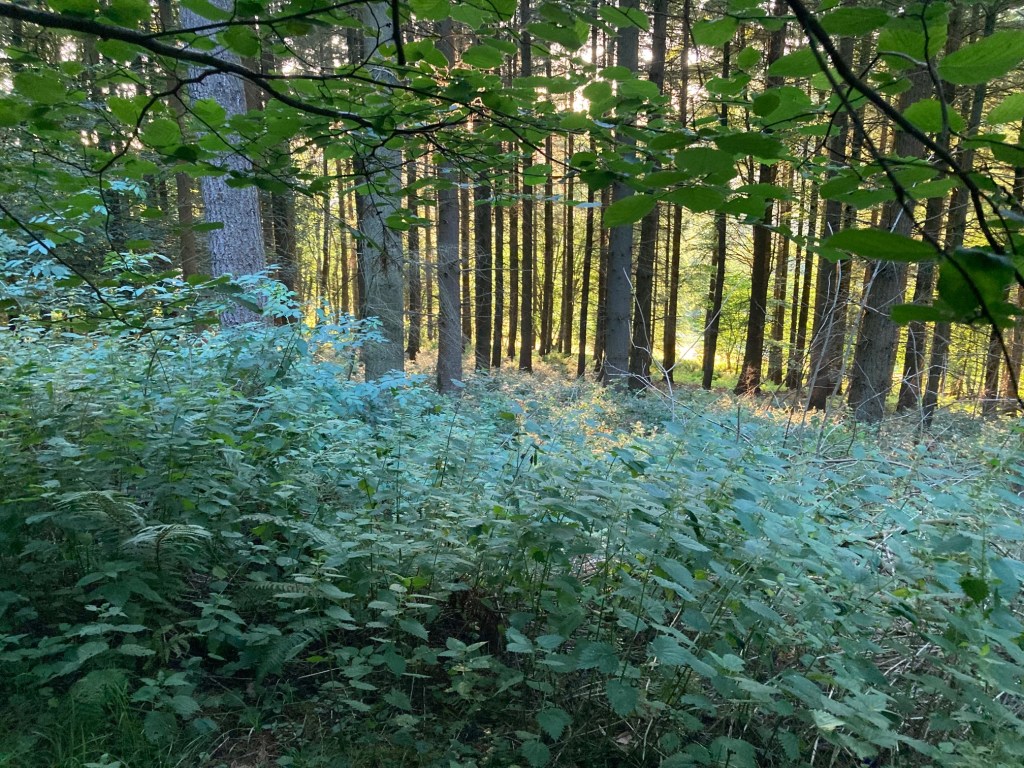
 The Forest
Leave a comment