Not long ago I spent a long week-end in the north. I paid for a room in an old inn on the moors, and spent three days walking, climbing and exploring the countryside. At the end of the first day – a Saturday – I returned to the inn after a fifteen-mile walk. My blood was still pulsing and gave more girth to my veins. A film of drying sweat lay on the surface of my skin.
The weather for much of the week-end was poor and the Saturday had been no exception. Intermittent rain had blighted the day, and the uninviting outlook was keeping the inn’s clientele in the comfort of their homes.
When I returned to the inn, only two other people had taken up seats in the bar. I had expected that, once I had showered and returned to take my dinner in the early evening, at least a few more patrons would have filled it out, but I was surprised to find only the same two people. One was a hoary old man with a shrub-like grey beard sinking into a soporific spell; he nestled into a rustic Queen Anne armchair by the open fire. The other was around forty – roughly my age – but a little old before his time, though this could have been a deception of the dimmed light and an impression I derived from the limited sight I had of him; he was seated at the bar with his back to me.
My stomach clamoured for food, so I ordered a large meal, then retreated to a quiet corner with a pint of brown ale. By this time the rain was wrapping at the window and the heavy clouds hastened the arrival of dusk. The barman brought me my meal quickly, and I showed my appreciation by eating in like fashion. The man at the bar glanced over his shoulder as the plate of steak-in-pastry landed on my table. In that fleeting look I thought I could detect that his appearance, and not just his age, resembled mine.
Once the food had gone, I was left supping from my pint and contemplating, through the corner of my eye, the lambent presence of the fire. The tiredness, the food and the first wave of alcohol must have taken its toll – my eyes were drooping, until a voice caught my consciousness before it slipped away.
“It’s a drab evening,” he said, or so I believe – my departing wits meant that I had no clear recollection.
“Yes,” I stammered.
In my half-awake state, I assumed that the voice had been the barman, but as I shook myself to attention, I saw that the voice was the man who had been sitting at the bar. Now that I could see his features properly, I could also see that the resemblance was only superficial. He was clearly older, with flashes of grey hair. His skin was somehow harsher, more leathered and worn. For all that, there was something familiar about him. I was sure that we had not met before, but in a more elusive sense, I knew him from somewhere.
“I’d say it’s settled in for the night. Perhaps it will clear tomorrow.”
“Let’s hope.”
The man looked doubtful.
“Sorry if I disturbed you. You were about to fall asleep, I think.”
“Not at all. You saved me from myself.”
“If that were true, it would be a worthy act of redemption.”
I laughed.
“I suppose. Please, sit down.”
The man took up the invitation, perching on the bar stool opposite. He carried his pint with him, and took a swig from it. He stopped to savour the taste, swilling it around the deepest corners of his gullet, before swallowing.
“Haven’t seen you here before.”
“No. That’s because I haven’t been here before.”
“A holiday, I expect?”
“That’s right. A bit of walking.”
“Is that it?”
“What do you mean?”
“We don’t stand on ceremony here – if, as you say, you are here to explore the countryside, then I will hear you; but I am here for the truth not the varnish of polite conversation.”
“What makes you think I’m not … ?”
“ … I reckon we both know.”
I considered this, and in a fleeting moment, the unusual nature of our encounter. By now, I was fully awake. The silence was long. I looked over at the fire, then back at the stranger before me.
“I came from the north, and for a long time I have wanted to return to it.”
“By that you mean you want to die?”
“Yes.”
“Why would you want that?”
“I feel sure that in some sense we know each other, and in knowing each other we understand each other.”
“Death is no picture.”
“Nor is life.”
“Perhaps.”
“I am weary with life, and the more I think about it, the more I believe I have always been weary with it. It’s a place of pain and cramped conditions, propelled and sustained by the strained selfishness of its participants.”
“That sounds very grand.”
“Death has been on my mind for a long time. If you want the unvarnished truth, there you have it.”
“Then you are disillusioned with it all.”
“Isn’t there a view that human striving is just the flicker of a passing shadow against the light cast by a fire?” I asked, glancing at our own small flame.
“There is.”
“And in that view, isn’t the proper business of life a preparation for death? Death is a just a journey, albeit one that needs to be charted and coursed with care.”
“Let’s leave that for now. What about life? What is it about life that you don’t like? In some ways – in many ways, in fact – you have many things.”
“They make it harder to give it all up, I grant you. But they are a short form of compensation.”
“For what?”
“If you have lived for so long and you are still lost, unknown, never really present. Secrets don’t keep well. The truth of someone is the only thing that really matters, and our material world won’t admit me. Despite my efforts, it never has.”
“Then try a little courage. Fight.”
“That is one way to look at it. To see it as a battle. Except my long-term thought has always been that in my timidity, my reserve, my worry and limitations, my loneliness, even my misfortune, I have been strangely fortunate. The glimpses I have seen of success over the years don’t really make me envious. Instead, I question whether the battle ever really returns anything of any great worth. The experience of failure and disillusionment instead give me a different glimpse – the sense of something beyond all that toil. Which is destructive and illuminating at the same time. And I wonder – if the most worthy fighter were to bring everything his character would allow, whether even then, secrets would remain. I feel sure they would.”
“I begin to see the progress of your thoughts.”
“The more I look, the more I see nowhere to go – there is no refuge, no home over the horizon, nowhere I want to go, nowhere that draws me out.”
“You see it as a sort of impasse.”
“Today, I walked all day and I didn’t see a soul. It was just me, the moors, the woods and the rest of nature. In that silence and solitude, things become clearer. Death has been calling to me for a long time. I have just shut it out.”
“Then let’s turn to death. Let’s look at it for a moment. Look at how people die, what they give up, what they leave behind. Look at all the pain it causes. How much sorrow is there, how much loss? How many permanent scars are there in the hearts of those left behind? There are many, as I’m sure you must know. Does that not mean there is – there must be – something of worth, something to seek out and cherish in the business of life? There are even many people who are desperate for opportunities and would resent the implication that life should be forfeited out of preference for death.”
“I’m not saying that living doesn’t have anything to offer. Some people are prisoners of their raging self-esteem; others, in their good fortune, may have stumbled across something worth preserving. I can reckon that as a distinct possibility – and I have seen it happen. But not in my case. And besides that, you seem to be implying the impossibility of the conclusion I have reached – something, for some reason, I find surprising coming from you.”
“It is my duty to counsel you in this fashion.”
“Do you deny that, for all the admitted good things that life can return, the ultimate orientation is towards death? That the end of life is a kind of liberation?”
“I do not.”
“Well then.”
“And yet the ‘journey’ of death is only the culmination of life’s pain. Think of the ways to die: cancers of the body, viruses and diseases, the accidents of nature (burnings, drownings, crushing, the violence or poisoning of other animals), or the dreadful conceited violence of humankind. There are reasons people go to such lengths to avoid these things, and in our day and age, these strategies are advanced and comparatively successful. That is a kind of achievement.”
“Or a more comfortable hole in which to bury one’s head. Those comforts are real enough, but what values sit alongside them? ‘Mercy has perished and the fierce man has descended on everyone.’ Isn’t that how it goes?”
“Your heart is hardened in this matter, I can see.”
“It is. From experience. Part of me longs to travel north. My guess is that’s true of everyone to some degree.”
“To some degree. Which implies a fraction of the whole that is still captured by living. How much of that fraction remains in your case, I wonder? Or are you giving yourself over entirely?”
I had to think about this question, and when I did I found that I was not so committed to the course as I had professed.
“Now that I think about it, I couldn’t honestly say I want to relinquish it all. Not without qualification, anyway.”
“I wonder if anyone ever could?”
“You might be right about that.”
“Because there is always some worth and dignity in any individual that, no matter how disillusioned or despairing, they will recognise.”
“I am confused by your counsel. However obscurely I know you, I felt sure that you would welcome my confession. I have wanted to unburden myself of these thoughts for a long time now – years, in fact.”
“I expect you say that because you know – albeit obscurely – that I am your companion for that journey you are itching to undertake. That’s true, but just as I am your companion, I am also your guide, and a good guide must, among many things, judge when it’s right to embark on a journey, knowing what lies ahead. I’m telling you what, on reflection, you have realised for yourself: that now is not the right time.”
The man with the grey beard sitting in the armchair by the fire had fallen asleep and gentle snores broke from his direction.
“Then what would you advise me to do?”
“Death will call you when the time is right. In the meantime, I would advise you to understand what it is that you do not yet want to renounce. That fraction, however small, may have surprising value. In the meantime, you can think of me and plan our journey together to the north when the time comes.”
The man, apparently knowing our dialogue had reached its conclusion, stood from his bar stool. He finished his pint.
“I hope you have a better day for it tomorrow,” he said.
“Yes, so do I,” I replied.
The man deposited his empty pint glass on the bar, with a nod to the landlord. Then he walked out of the front door of the inn into the raging tempest now shrouded by the dark night. For a time, I watched the fire crackle.
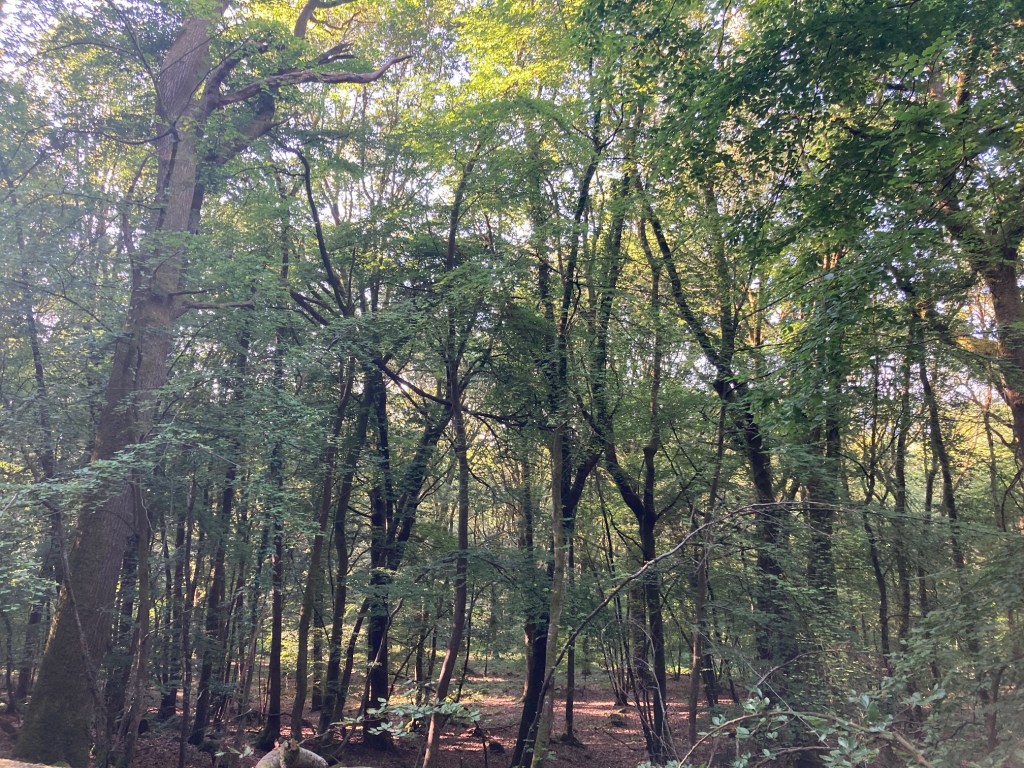
 The Forest
Leave a comment