Social anxiety disorder is not uncommon. Its prevalence globally is between five and ten per cent. Which means over 400 million people worldwide may experience it to some degree.
For the afflicted, these numbers might provide some comfort, but they can also relegate its significance, especially next to more dangerous and debilitating disorders. Indeed, I have sometimes thought that the condition is a bit effete and mediocre; for some, it might earn a modest amount of sympathy but more likely it will be met with the question ‘You mean, you’re shy?’, or a tacit suggestion that you should just grow a pair. It’s bad enough to be a real problem but not bad enough to warrant much attention.
In a sense maybe that’s right. There are definitely worse ailments. One of its least attractive qualities is also a kind of unwanted narcissism, in which sufferers indulge the paranoid fantasy that everyone they meet is thinking about them. So, perhaps giving it too much attention is something to be avoided.
From experience, much of the therapy directed at treating it is also expressly designed to keep it under control. A metaphor described to me likened those who experience it to the driver of a bus and the anxiety to an unruly passenger who climbs aboard. The aim of the treatment is not to eject the passenger but ensure they don’t cause the driver to crash the bus. Therapy becomes a study in stoicism, or a Buddhist-like detachment from the bogeymen in your brain.
At its simplest, social anxiety disorder is a fear of social judgement. Sufferers spend their time in company worrying about how they might be perceived and judged. To manage or control their fear they deploy, often ineffective, strategies, like trying to second-guess what people in their crowd are thinking, over-preparing, over-analysing and ruminating once the situation has ended, or just avoiding people altogether.
Because company is a cause of fear, it can also cause a fight-or-flight response: some people become aggressive and others just want to run away. The heart races, you start to sweat, you avoid direct eye contact with people, you can’t concentrate on anything anyone is saying, you flail and flounder, gesticulating wildly. At the end of it all, you feel the sustaining relief that you have got through it and the sort of adrenalin that might follow from performing on stage or jumping out of an aeroplane. Then you start scrutinising all the things that happened, which can last for hours, days, or even years. Finally, you feel physically exhausted.
That’s how, in my experience, a typical event plays out. Much of this reaction is also involuntary and not something you can bring to heel with a bit of cool and calm persuasion. I also, for example, experience a degree of vertigo. Some people trot like mountain goats across Helvellyn’s Striding Edge, knowing that, so long as they take care, they are unlikely to come to any harm. Except, if the experience of heights does peculiar things to your mind, being clear-headed about this has no bearing on your ability to put one foot in front of the other.
A point worth bringing into relief, therefore, is that much of what the larger part of humankind considers pleasure, or even an elemental purpose at work in human nature, is for people with social anxiety a cause of discomfort (to say the very least). I struggle to think of any social event that I have really enjoyed. Where I know one is on the horizon, I spend my time somewhere on a spectrum of mild agitation and outright dread. In the event itself, my deepest instinct is to look forward to the point at which it is over. So people are not a source of comfort, nourishment, pleasure and fulfilment. They are a perceived threat.
The emphasis is deliberately on the word ‘perceived’ because I am writing about a disorder or a distorted view of reality. The easy and most instinctive line of thought for anyone with social anxiety is to think that because it is other people who cause the pain, then it is other people who are the problem. The rigid values of society judge, condemn and reach a pitch of intolerance in a way that makes human beings seem almost insufferable.
The fear might be insurmountable, but it doesn’t take a strained attempt at objectivity to realise that things, in themselves, are more complex. Some people are quick to judgement; for others it scarcely crosses their mind. In either case, everyone has their own perspective. People generally – in their twin guise as subjects and objects – are such a catholic cast of characters that it is impossible to attempt a single judgement.
Most of the people I have spent my time dreading are nice, interesting, thoughtful, fun and kindly – people I should really be glad to know. I spent weeks routinely avoiding invitations to go to a pub quiz with a couple I would classify as close friends. I once retreated in tears to my tent at a party (at which everyone was camping), despite the general good cheer of most people there. I have lived in fear of weddings, parties, and dinner parties, concerts, meetings and seminars – all with people who are interesting and have often gone out of their way to be kind.
A meeting, a few drinks down the pub, a meal in a restaurant, a dinner party, a conference, even a conversation at the checkout in the supermarket – these are all single events, which may not amount to much, but add up to something more significant. They produce a kind of non-life, or death-in-life, a failure to grasp the opportunities that occur naturally.
Between the ages of twenty and thirty-seven I had no relationship with anyone and I could count my friends on one hand. Other people I knew got married, had children, took out mortgages, progressed up the career ladder, charted their own network of relationships. As these events unfolded, a simple sense of comparison leaves you feeling like a pariah that life has left behind. And burgeoning out of the moments of social phobia comes a generalised depression that, at its height, took its ugliest form in repeated thoughts of suicide.
Since so much flourishing is greased by human relations, avoiding them costs dearly. Some careers require less human interaction, but most depend on it to some degree. The sort of psychological tangle that the condition engenders throws up further obstacles. Not least it becomes especially hard to demonstrate whatever capabilities you have. A few years ago, for example, I can remember being asked to read and comment on a press release in a meeting. Someone slid the text on a piece of paper over the table towards me. I pretended to read it but was incapable of understanding anything. So I simply nodded my head and said it was fine. After the meeting, I read the press release at my desk and spotted so many things to question that I would have probably re-written the whole thing.
This is another small example, but it illustrates a mindset that, writ-large, casts a shadow. I am naturally very interested in a range of things. But I suffer from the long-term sense that I have not fulfilled my potential because it remains hidden, or I am incapable of letting it show. Not least because part of ‘letting it show’ means taking the risk of thriving on the spontaneous thought and reaction of others. It is simply not enough to prepare and assimilate information quietly. Knowledge and development are unavoidably communal.
Look at the consequences: no family, no children, few friends, stunted social, professional and intellectual development, and to be metaphysically despairing, the sense that you are passing through life unknown, boxed-in by a permanent sense of fear.
Therapy has the ultimate aim of training patients with techniques and hard-won habits that mean they are not blighted by the sort of experiences I have summarised. The aim is to keep the bus on the road and reach a destination in tact. A lot of these techniques are practical. They explore what the patient would like to achieve, and help them to develop techniques for doing so. Aims tend to bring patients in from the cold by helping them to manage the clamorous racket in their heads. This is important. Nonetheless, I always felt a little ambivalent about it. At times, it seemed to imply the forced return to a uniform standard as an implied starting point from which to flourish. Except, in repressing one side of life, it can often feel like anxiety stimulates others.
Ian McEwen’s 2007 novella, On Chesil Beach, has always interested me. With the warning that I am spoiling the plot, it tells the story of a couple – Edward and Florence. It is set in the more socially conservative atmosphere of 1960s Britain before the revolution in social liberalism has got going. The couple are on the first night of their honeymoon and about to consummate their marriage. All the anticipation and neurosis that leads to the gruesome deed means that it ends in disaster and the young bride takes tearful refuge on the eponymous beach. The couple agree an annulment but Florence eschews the prospect of love altogether and becomes a successful musician. In later life, Edward maintains a wistful fascination with her, claiming that he has never loved anyone as much.
On our side of the 1960s, we privilege self-expression and choice. From this moral vantage, the story is suffused with sadness. But I have always thought that its real hold on the reader lies in the way a dramatic moment crystallises Florence’s subsequent career and animates Edward’s lingering obsession. The anxiety brought by the formalities of a more traditional culture transforms or ‘sublimates’ the sexual moment. The redeeming purpose of cognitive behavioural therapy for social anxiety disorder is at least analogous to a liberal reading of McEwen’s book. But just as Florence’s experience lends her, and her music, an extra lustre, the ‘inward journey’ that social anxiety encourages can be similarly transforming. (For similar reasons I have found myself fascinated by similar stories – A Death in the Family by Karl Ove Knausgaard, The Remains of the Day by Kazuo Ishiguro, A Shining by Jon Fosse and the French film by Claude Sautet, A Heart in Winter, all come to mind.)
Most people, albeit to different degrees, have an appetite for expression – this is something that occurs naturally. But for those with the disorder an excessive drive for control – motivated by fear – censors and represses the vital energies that incite it. That doesn’t mean the vital element disappears; it may just take a different form that works itself out through an intense passion for something else (music, art, literature, football, carpentry or more). The tangled psychology changes the individual, recreating them in a different guise. The oddity of my experience is that having failed on most measures of professional and social preferment, I don’t feel a burning resentment and desire to capture all the things that in my youth I never experienced. Such an aspiration jars with who I am. I may have felt the pain at the time, but the experience changes you. It is like a little death, the other side of which is strangely liberating.
I would even suggest that there is, by analogy, something instructive about the disorder. Our society, in the terms of McEwen’s novel, emphatically wants consummation and is mystified by the idea of anything else (sex, sex and more sex, it shouts!). We live with a conviction, an assumption, a horizon of moral values, and at its worst, a sense of entitlement, that it is right to bring wishes to fulfilment – in other words a conviction that is unabashedly hedonistic. So much assumes that not only is it right to satisfy desire but that it can be brought within the orbit of human influence, then controlled, managed and directed. This humanistic, anthropocentric outlook is sometimes explicitly stated but often more implicitly at work in many areas of modern culture – politics, art, economics, personal relationships and morality.
If desires can be arrogated to the exercise of an individual’s will, then maybe this position entails. But if the individual is a less uniform assembly of unique personality traits, particular circumstances and relationships that they cannot possibly transcend, then this morality is the real narcissistic delusion. The moral psychology of personal fulfilment becomes, hypocritically, a naked act of selfishness and aggression that bulldozes towards its objective with little or no self-awareness, or even unfeeling indifference. The idea of subjects empowered by equal access to essential powers of free choice is partly implied by the aims of therapy, for which in my case the aim should be to interact, converse and engage in a way that might pass as ‘normal’, or which becomes no obstacle to aims and objectives that might count as normal.
Except, as I say, the effect of a disorder is not to place an individual in a straitjacket from which they are desperate to escape. A nearer parallel is someone who has lost the use of one limb and compensates by building up strength in another, to the point where that becomes their own mode of existence, one that has shaped their character and bearing on life. Settling into a frame or a form, however contorted or ‘misshapen’, fosters a distinct character.
The form matters because it mediates the way a particular instance of life finds expression, imbuing it with its own cadence and colour.
If the idea of individual autonomy is a modern myth, it forces subjects to acknowledge and come to terms with the natural horizon of their lives – in other words, to embrace reality. Inhabiting a body, of whatever sort, in whatever circumstance and even where it is not encumbered by disorder, creates conditions that no assertion of free choice will ever overcome. The ‘inconvenience’ of social anxiety disorder might therefore be understood as an extreme or exaggerated experience that, in one way or another, everyone experiences. Everyone has to settle into a frame or form of life. No amount of modern chicanery gives people an entirely independent perspective with the licence that entails. Coming to terms with that horizon, understanding it, even nurturing it, is arguably an essential task that confers a kind of comfort, peace and freedom.
Which is all very well if that is achievable. Perhaps if you are Florence and have had the opportunity to develop your art, then some kind of light at the end of the tunnel awaits. That kind of experience might obtain for a few – and if it entails anything to do with the arts, mostly likely it will be a financially privileged few. But, in general, is society receptive to the differentiated expression of life through multifarious forms? I suspect the answer is no.
The academic literature, as far as I can make it out, argues over the different causes of social anxiety. Some talk about genes and social adaptation; others about humiliating experiences from childhood. I can’t claim to have studied the condition empirically, but I can lay my own experience bare. I was, without doubt, a shy and reserved child. But I did not become socially anxious until much later; I would say until I was at least twenty. And to my mind it coincided with all the pressures of becoming an adult, getting a respectable job and getting married. In other words I associate it with attaining to a high-status, middle-class and professional socioeconomic ‘rank’ within society. Even now, the thing that causes me most neurosis and irrational fear is the thought of applying for other jobs.
The source, to my mind, was and is the sterile uniformity of a specifically liberal, bourgeois mode of existence, one that wants to single out the individual and elevate them by the achievements of their brains and initiative. It is an ethos and a set of values that remakes and re-engineers everyone in the same mould so they can be judged by the same standard – to the extent that all the young professionals who work in the city of London wear the same shoes, trousers, and take to the gym twice a day so that they can showcase the same buns. It is an ethos that doesn’t understand people as people, with the arcane and contingent eccentricities that draw out their character, but reduces them to a clumsy automaton whose value – or ‘success’ – is measured only by a set of pretty crude calculations.
In this world ‘form’, whether ordered or disordered, doesn’t figure at all – it must all be brought back to the same starting point, to the same abstracted metrics and insipid production units. My sense is that life wants to be known, wants to remake itself and is creative in the way it goes about it. My experience tells me that you can find a way of living that will accommodate the crosses you have to bear. Except this is not tolerated by a view of things that wants to control, manipulate and regulate the conditions for flourishing. The irony and hypocrisy of such a putatively liberal culture is that it is anything but.
If there is a straitjacket, therefore, I would identify it with the rigid positivism of liberal political economy. And I would hazard a guess that if anyone has the data to track incidents of phobias like social anxiety, they will find that they increase the more societies embrace liberal individualism (in, for example, the period of the last forty years as we have rediscovered our own version of nineteenth century liberalism).
A flower, if it is placed under a shelf that shelters it from the sun, will grow around it. Our civilisation responds by pushing it further into the dark.
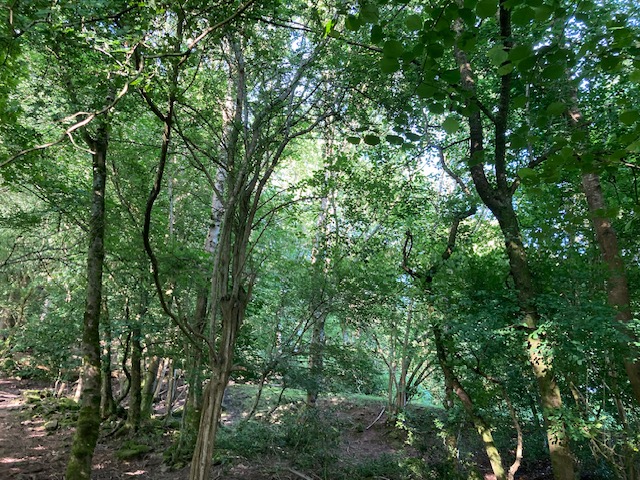
 The Forest
Leave a comment