Not long ago I went to the Tate Modern for the first time in many years. In a couple of hours I wandered around some of the free exhibitions, beginning with the most recent experimental stuff and ending up with the more established prospect of Paul Cezanne and Georges Braque.
Most of it I spent rolling my eyes. Except I have always assumed that this is part of the fun. Possibly, you are meant to take it seriously. No doubt some people do. But a lot of it I spent trying to hold back quizzical expressions and the voice in my head which said ‘This is just a lot of bollocks’, even though a lot of it plainly is.
Not much of it stands out in my memory, but I didn’t make much of an effort to remember it. I recall a man weeing on a table, a video of a man being painted light blue and a room with printed statements on the wall like ‘It’s easy to walk home at night with a bag of skittles’, to which the easy retort is, ‘It’s also easy to write any old crap on the wall of an art gallery and call it art.’
It must be at least ten years since I last went there. I can vaguely remember reacting in a similar way at the time, except, with age, I might have become a little more conservative and cynical. Still, the visit was one of the highlights of the day, so whatever the merits of the art, something about the experience was special.
It might be a marker of my age and the same slow turn to a more traditional frame of mind, but I only really felt the electric charge of curiosity once I found Dali, Mondrian, Cezanne, Matisse, Braque and a clutch of other paintings I vaguely recognised.
Which made me want to stray into the questionable territory of an amateur critic. I started by casting suspicion on myself. It’s possible – more than possible – that I have become more set in my ways and less open to conceptual provocations. Post-impressionism, expressionism and surrealism, in that line, become peculiarly traditional to the point that they are almost comforting, a form of art that I can, without any great knowledge, compartmentalise and appreciate. But I no longer have the spirit to contend with the artworks that are, in our cultural moment, unsettling and profane.
That’s the sort of progressive mindset which says that impressionism might be the ‘nice’, aesthetically pleasing and acceptable face of art today but was, in the world of the nineteenth century salon, radical and avant-garde. Except the abiding impression I had of almost all the more recent exhibitions was that they come from a playbook of political gesture that felt dated ten years ago. In other words most of the exhibitions were totally – even staggeringly – predictable and dull. They were, you might even say, conservative.
My fleeting impression of culture generally is that the Tate Modern is no exception and that ‘high’ culture (from the fine arts to literary fiction) has turned stagnant. It knows what it is; it has an established identity with established values (even where those values become empty gestures without line or form, a deliberate attempt to enfold one or more of the protected characteristics that together we spuriously call ‘diversity’, or a deliberate attempt to grab headlines in a right-leaning newspaper). Progressive culture has been living in an SW1 postcode for many years. Without any dramatic tension to give it purpose, it has become as institutionalised as the House of Lords.
Which might not matter if it weren’t so hypocritical. By walking a ‘transgressive’ line it repudiates everything that has gone before it and, ultimately, itself. This leaves only a commercialised space for punters to bring their children.
My alternative interpretation of the paintings that I actually liked was that they had something about them – some substance, a skill, a form, an idiosyncratic vision, an authenticity, an unresolved tension that, even where it was familiar, was still fresh, striking and surprising. Even where they ultimately defy this easy categorisation, many of the paintings share a loosely modernist sensibility in which the echo of something representative and real has started to fracture into nostalgic memory, experimentation, the pure form of abstraction or even forward-looking disdain for the past. The memory of something ‘real’, however, brings them to life and gives them an immediacy that is, at the very least, relatable.
I spent some time in the gift shop afterwards and I decided to buy Kandinsky’s Concerning the Spiritual in Art. In this book you can see the thought behind his paintings at work. The job of the painter is to draw out the ‘spirit’ or inner form of the study, rather than getting lost in the trite materialism of literal representation. By working with form and colour the painter can abstract the inner truth or higher form of things. Looking at his paintings you can see how his work develops from impressionistic representation towards this sort of pure abstraction.
Whatever you make of the theory, Kandinsky’s obsessive pursuit is apparent in his work and the search for a distilled essence aligned to inimitable style lends his later paintings an undeniable character. But perhaps Kandinsky’s search for abstract form is, in the end, a dangerous game – it too easily collapses into the sort of vacant experimentation that typifies the displays of so many modern art galleries. By abstracting, the substance becomes so diffuse that it loses sight of anything, and all that remains are futile exercises, agitprop self-determinations – or the nihilistic impasse of postmodern play.
It’s possible, instead, that ‘inner form’ needs an extrinsic character for it to bear witness. The route to something real relies on a careful study of the particular – a particular object, such as a tree or the portrait of an individual, or the unique perspective of a particular artist (or both). Finding this sort of character, in the fine arts or elsewhere, is the hardest and most discerning task, but it is often the task that surprises and commands the attention of spectators, witnesses, and readers. These rare works call out to spectators; the medium of something irreducibly particular establishes an immediate rapport and invites witnesses to share or explore the deeper layers of interest it contains. Character – or, in a different mode, virtue – is like a call or an enticement whose outward charm leads the way to inner riches.
In my brief middle-aged visit I was not unlike Pirandello’s famous characters in search of an author – I was a member of the public in search of some art. As someone who has been willingly – and, by secular standards, eccentrically – participating in high-church ritual for a number of years, I was also struck by a certain similarity between church-going and visiting an art gallery. At communion, evensong or even the Elizabethan lyricism of the Book of Common Prayer, congregants yield to manifest beauty, except the beauty is sacramental; it signifies divine mystery and brings worshipers into its presence. For the briefest time, it sweeps away the accreted layers of spiritual alienation. The aesthetics or the appearance of beauty – the music, the choral anthems and canticles, the words, the glorious architecture – is the outward sign of the wonder it evokes. This beauty is inseparable from liturgical place and purpose, all of which is felt or sensed in the act of worship. Churches and their rituals call congregants to this mystery; if you visit a church in the quiet of the day, you can sense its life and the echo of the long tradition to which it belongs.
When I visited the Tate Modern – perhaps because I am now conditioned by an excess of Anglicanism – I was looking for the same connection, anticipating the same evocation. The instinct was there but it was not answered by anything, because contemporary culture makes a virtue out of having nothing to offer. All I found was a gallery. Which may make the Tate Modern an especially apt symbol. Modern art galleries contain the echo, or the fragments, of beauty but have created spaces in which to lose it. What beauty once meant has been lost to the featureless plain of a reasoned answer or the strange distortions and presumptions of modern anthropocentrism. It has been lost because modern societies don’t acknowledge or celebrate the particular; they have a universalising gaze that subordinates everything to the same standard. They are attempts to manage and control.
It is no wonder that the natural appetite for beauty has become a sad spectre of denuded walls.
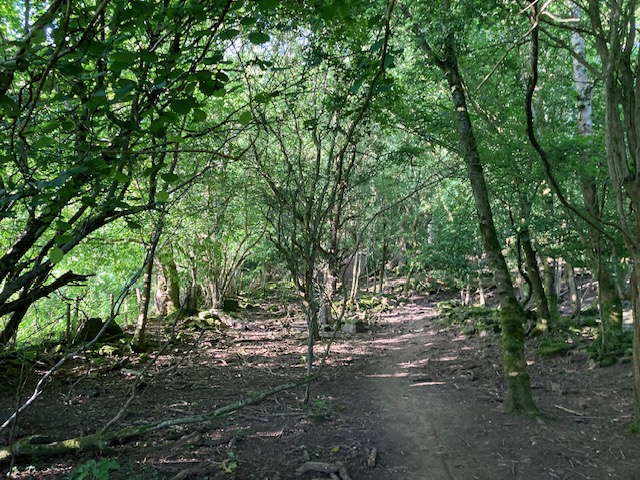
 The Forest
Leave a comment